Access shared folders
This guide is for end users who have been granted download and/or upload access to an accsyn shared folder or collection.
You typically get access to a specific project subfolder on production storage — not the whole disk. Transfers can run in the browser for simple cases, or over the secure, accelerated ASC protocol via the Desktop App for large or resumable work.
Important: If you received a delivery, use the link in the delivery email and follow Receive a delivery. This page is for permanent (or long-lived) shared folders and collections on accsyn storage.
Email notification
When someone grants you access to a folder in an accsyn workspace, you should receive an email with a direct link to that share. Example link:
https://accsyn.io/shared/VuPd4yGxNVE5ryBo
If this is your first time on the platform, you also receive an invitation explaining how to activate your accsyn account.
Note: If you cannot find these emails, check spam. Search for sender noreply@accsyn.com.
If you received no email, sign up at https://accsyn.com/signup with the same address the share was sent to. After sign-in you are taken to Shared with me, where you can open the share.
Primary method — open the share in the web browser UI
The primary way to access a share is to follow the link in the email. That opens the share in the accsyn web app, where you can browse folders you are allowed to see.
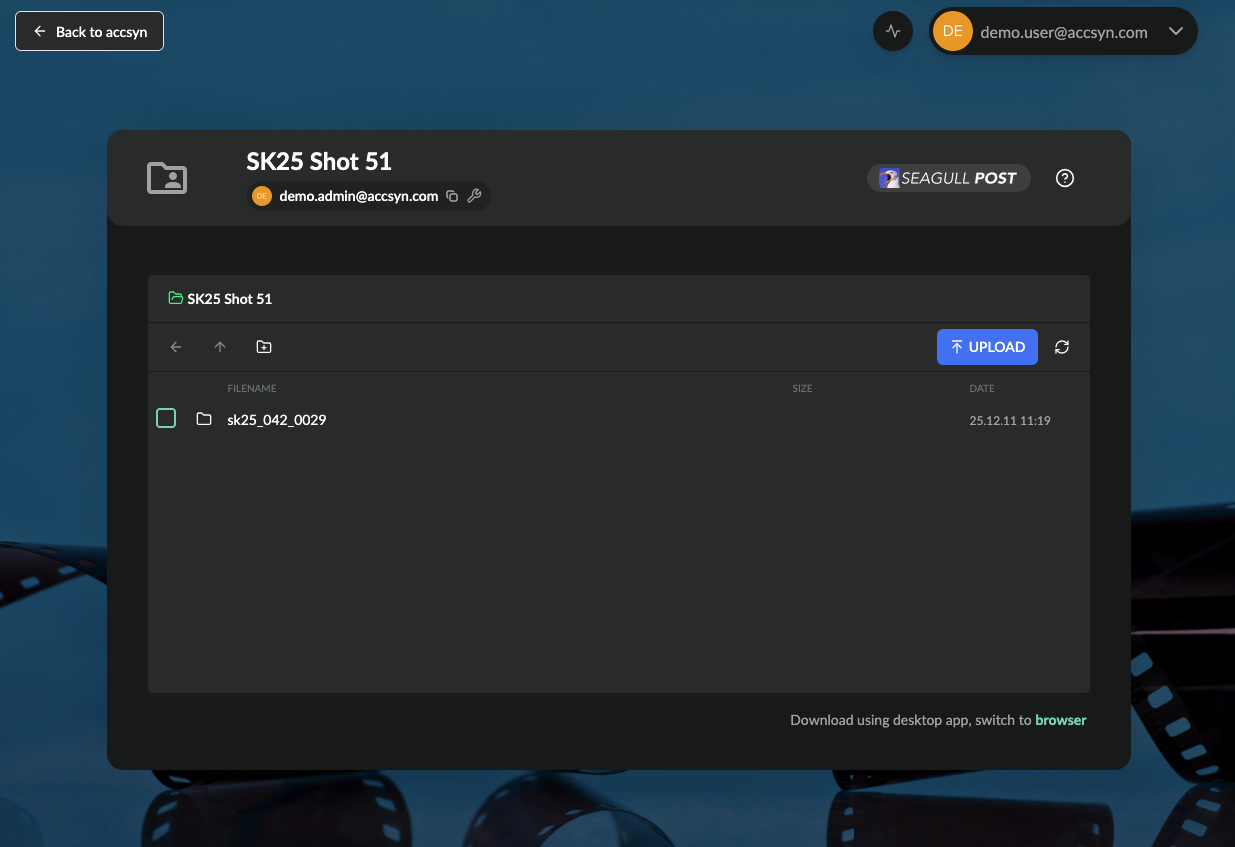
Access a share with the web browser.
Permissions
What you can do depends on the ACL for the folder you are browsing:
- Read — browse and download.
- Write — upload files into the current folder.
- Rename / move / delete — change or remove items (where granted). These rights usually follow write access on that path.
If you try to create a folder, upload, rename, move, or delete without permission, the web app warns you and asks you to navigate into a folder where you have write (or the relevant) permission.
Download
- Select one or more files or folders in the browser.
- Click DOWNLOAD.
- Prefer the Desktop App for folders, multiple files, large sets, and resumable transfers (ASC).
- For a single file, you can also download in the browser. Browser download does not currently support ZIP packaging of folders or multi-file selections — use the Desktop App for those. Browser multi-file / ZIP support may improve in future releases.
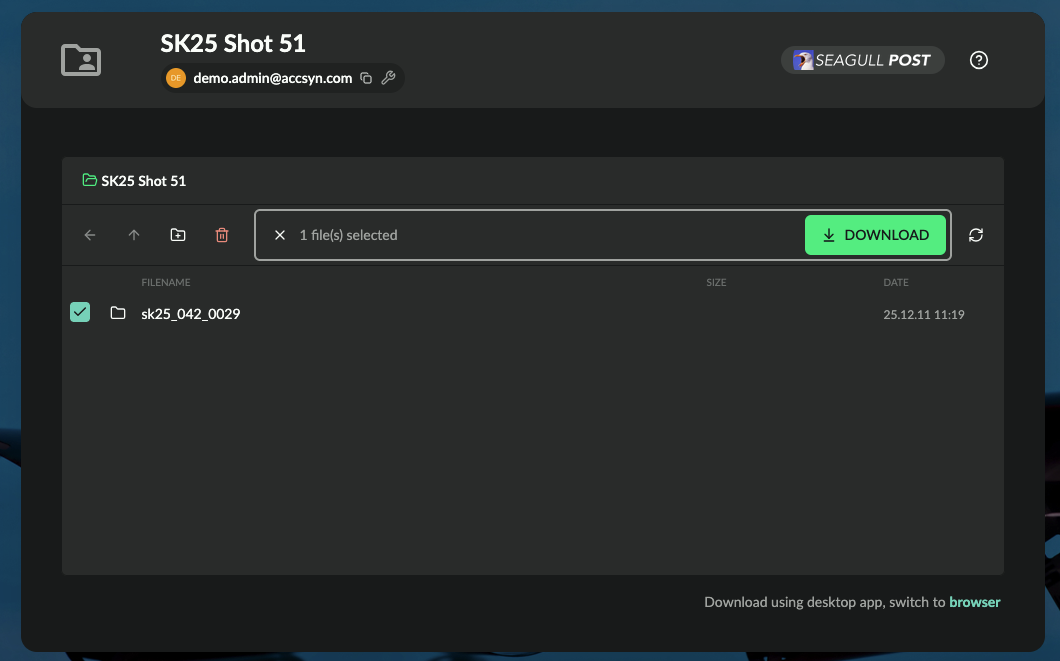
Download a directory from the share page.
Upload
- Browse into a folder where you have write permission.
- Click UPLOAD.
- Prefer the Desktop App for large uploads, folders, and resumable transfers.
- For smaller single-file (or modest browser) uploads, you can use the browser drop zone in the upload dialog. Very large selections may require the Desktop App.
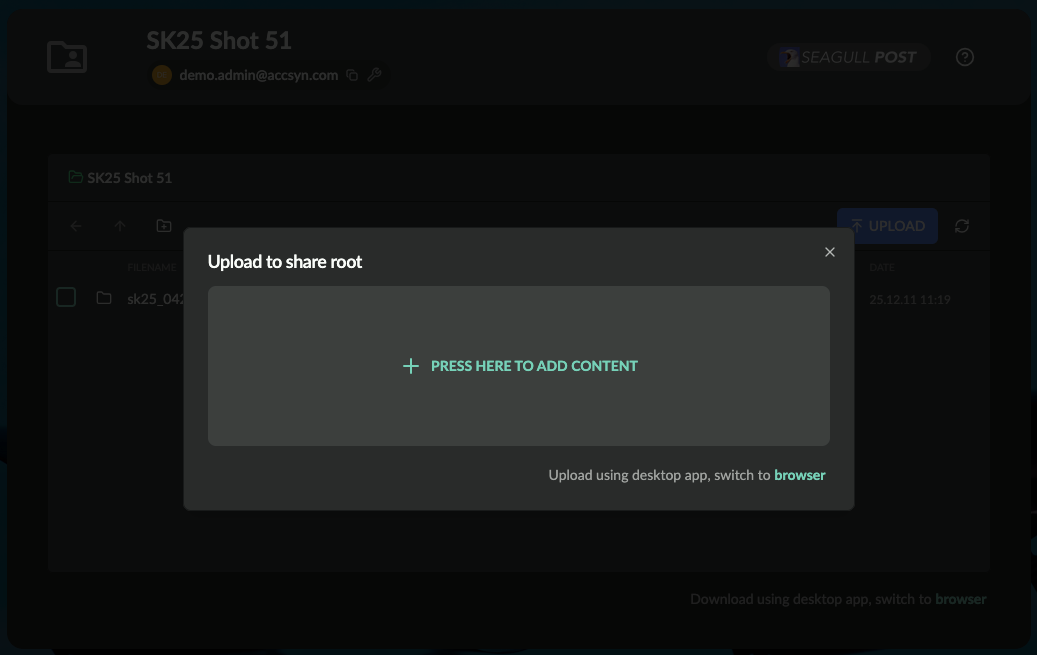
Share upload dialog.
Rename, move, and delete
In the browser file list you can:
- Rename — right-click an item → Rename, enter the new name.
- Move — right-click → Move, pick a destination folder inside the same share (destination must allow write).
- Delete — right-click → Delete, or select one or more items and use the trash icon in the toolbar. Confirm before deletion.
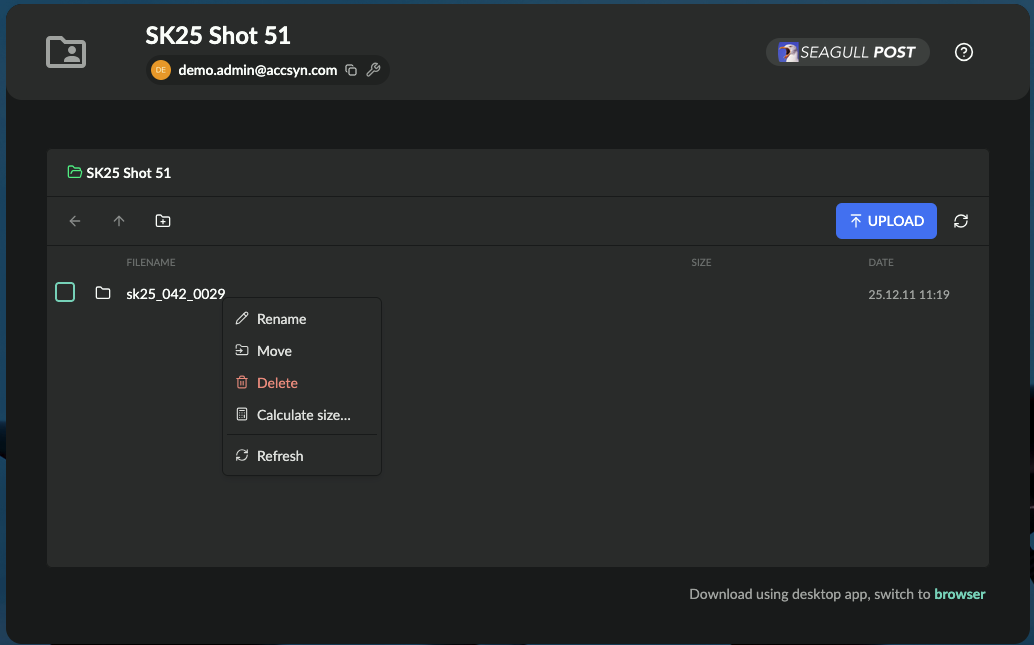
File modification right click context menu
When to use the browser vs the Desktop App for transfering files
| Task | Recommended |
|---|---|
| Quick look / browse the share | Browser (email link) |
| Small single-file download or upload | Browser or Desktop App |
| Folders, many files, large volume | Desktop App (ASC, resumable) |
| Rename / move / delete in place | Browser (or Desktop App Storage tools for operators) |
Overall recommendation: transfer using the Desktop App for day-to-day production transfers. Use the browser for convenience on single files and light management; browser folder ZIP / multi-file packaging is not available yet and may improve later.
Secondary method — Desktop App GUI
Use the Desktop App when you need accelerated, resumable ASC transfers, large folders, or the advanced dual-pane Transfer tools.
Installing the accsyn Desktop App
Follow Install Desktop App.
Downloading files (Desktop App)
- Launch the Desktop App.
-
Sign in with the email address the share was sent to. You should see notifications for accessible items:
-
Click the green Download button.
Note: If you dismissed notifications, open Download in the top area to launch the download tool.
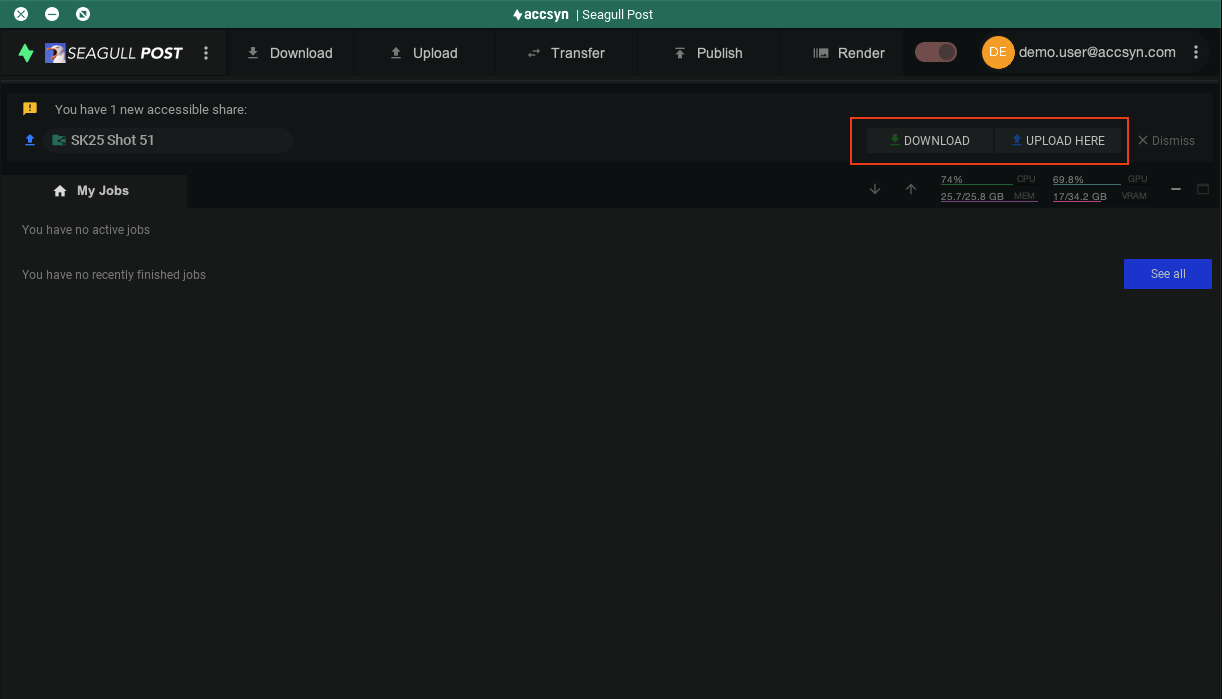
Share notification and action buttons.
-
Select which files and folders to download and the local destination:
-
Click Download to start the transfer (ASC via the Desktop App).
Monitor progress in My jobs at the bottom of the app — ETR, and clues if the disk is full or permissions/network fail.
Upload files (Desktop App)
Launch the app, sign in, and click Upload:
Choose the file(s) and/or folder(s), set Destination to the shared folder, then Upload.
Advanced mode — Transfer
If you are used to FTP clients, use the Transfer view:
Source on the left, destination on the right. Click the green arrow in the middle to start the transfer.
Manage app
Installation location
Default locations for standard users (no admin rights):
- Windows —
C:\Users\<user account>\AppData\Local\Programs\Accsyn - Mac — chosen by user; recommended:
/Users/<user account>/Applications - Linux — chosen by user; recommended:
/home/<user account>/.local
If installed as administrator / with elevated privileges:
- Windows —
C:\Program Files\Accsyn - Mac — recommended:
/Applications - Linux — recommended:
/usr/local/accsyn
Data files location
- Windows —
C:\Users\<user account>\AppData\Roaming\accsyn\data(under%APPDATA%) - Mac —
~/Library/Application Support/com.accsyn - Linux —
/home/<user account>/.accsyn/data
Elevated installs:
- Windows —
C:\ProgramData\accsyn\data - Mac —
/Library/Application Support/com.accsyn - Linux —
/var/lib/accsyn
Hint: back up and migrate this folder when moving machines to keep login and client credentials.
Log files location
- Windows —
C:\Users\<user account>\AppData\Roaming\accsyn\log - Mac —
~/Library/Logs/accsyn - Linux —
/home/<user account>/.accsyn/log
Elevated installs:
- Windows —
C:\ProgramData\accsyn\log - Mac —
/var/log/accsyn - Linux —
/var/log/accsyn
Hint: ZIP this folder and attach it when opening a support ticket for stability issues.
Uninstall app
As a standard user:
- Windows — run
C:\Users\<user account>\AppData\Local\Accsyn\uninstall.exe - Mac — move the
.appbundle to Trash - Linux — remove the application folder
Elevated installs:
- Windows — run
C:\Program Files\Accsyn\uninstall.exe - Mac — typically remove from
/Applications - Linux — typically remove from
/usr/local
Note: The uninstaller does not remove data and log files; delete those manually if needed.
Troubleshooting
I am not allowed to install apps on my computer
You can still open the share from the email link in the browser for browsing and single-file transfer. For large folders and resumable ASC transfers, ask IT to whitelist the Desktop App, or use another machine (for example a personal laptop), then move files via USB if needed.
Download turns red and fails (Desktop App)
- Check free disk space on the destination drive.
- Whitelist the executable and allow outbound TCP from port 45190 upwards (ASC).
- Confirm the app can write to the download folder (or read files you are uploading).
Browser download or upload fails
- Confirm you have read (download) or write (upload) on the current folder.
- Try a single file; folders / multi-file browser packaging is not supported yet — use the Desktop App.
- Switch the transfer preference to the Desktop App if prompted for large sizes.
Can I download from several machines?
Yes. Access lasts until revoked. You may use the browser and/or install the app on as many machines as you need.
Is the transfer encrypted?
Yes. accsyn uses AES encryption (AES-128 by default). The Desktop App accelerates transfers with the proprietary ASC protocol — suited to large folders and many files.
The Desktop App freezes or crashes
Email support@accsyn.com with log files attached (see log locations above).
Further questions: chat or support@accsyn.com.
Related articles:
Collaboration — share folders with employees and external users.
Hosts — automated deliveries and locally mapped shares.
Python API — automate shares and ACLs.